

Jacobus Theodorus Tabernaemontanus
Bergzabern
1525 -
Heidelberg
1590
Jakob Theodor named "Tabernaemontanus" after his home town of Bergzabern in the Palatinate region of Germany, was born in 1525 and died around 1590.
Little is known about the life of the "father of German botany". In 1545 Jacobus Theodorus Tabernaemontanus was first mentioned as a student of Hieronymus Bocks. In 1549 he was the private doctor to Count Philipp III of Nassau-Saarbrücken-Weilbrug and from 1562 he studied in Heidelberg.
In 1564 Jacobus Theodorus Tabernaemontanus worked as the private doctor of the bishop of Speyer, Marquard von Hattstein, and later as town physician in the independent city of Worms.
Tabernaemontanus spent the last decades of his life in Heidelberg as the private physician to the prince elector. He was said to have been married three times, having fathered 18 children.
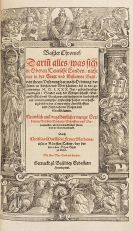
Tabernaemontanus's most important work is the "Neuwe Kreuterbuch", published in 1588, an opulent foliant including over 2300 woodcut illustrations, which Jacobus Theodorus Tabernaemontanus worked on throughout his life. Written in the tradition of the then known books on herbs by Brunfels, Fuchs, Bock and Mattiolli, his work differs significantly from that of his predecessors due to the better woodcuts and very apt descriptions.
But in his book the botanic aspect took a less important role than that of the medical information. The work was reprinted in numerous editions until the 18th century.

Would you like to sell a work by Jacobus Theodorus Tabernaemontanus?
Infos for seller


Starting bid: 4,500 EUR